Horse Genetics 101: Coat Colors, Breed Crosses, and Breeding Smart
Ever wondered why two bay horses can have a chestnut foal, or why some palominos always seem to have palomino babies? It all comes down to genetics, and the basics are easier than you think.
This guide covers how coat colors work, what happens when you mix colors and breeds, what to avoid, and how breeders use DNA tests to make healthy foals.
Genetics in 60 seconds
Every horse gets two copies of every gene: one from its mom (the dam) and one from its dad (the sire). Each parent passes on only one of its two copies, chosen at random, like flipping a coin.
- Allele: one version of a gene. We write them as letters, like E or e.
- Dominant (capital letter): you only need one copy to see it.
- Recessive (lowercase letter): you need two copies to see it.
- Carrier: a horse with one hidden recessive copy. It looks normal but can pass it on.
- Genotype: the letters (what’s in the DNA). Phenotype: what you actually see.
The three base colors
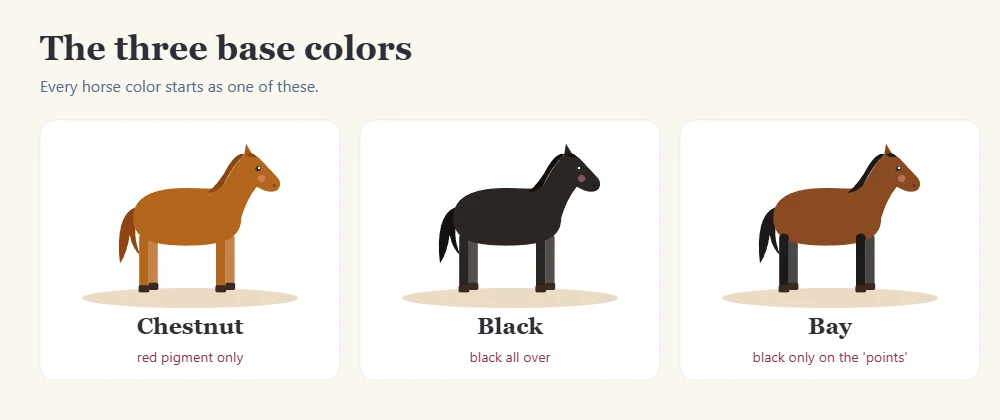
Every horse starts as one of three base colors. Two genes decide which one.
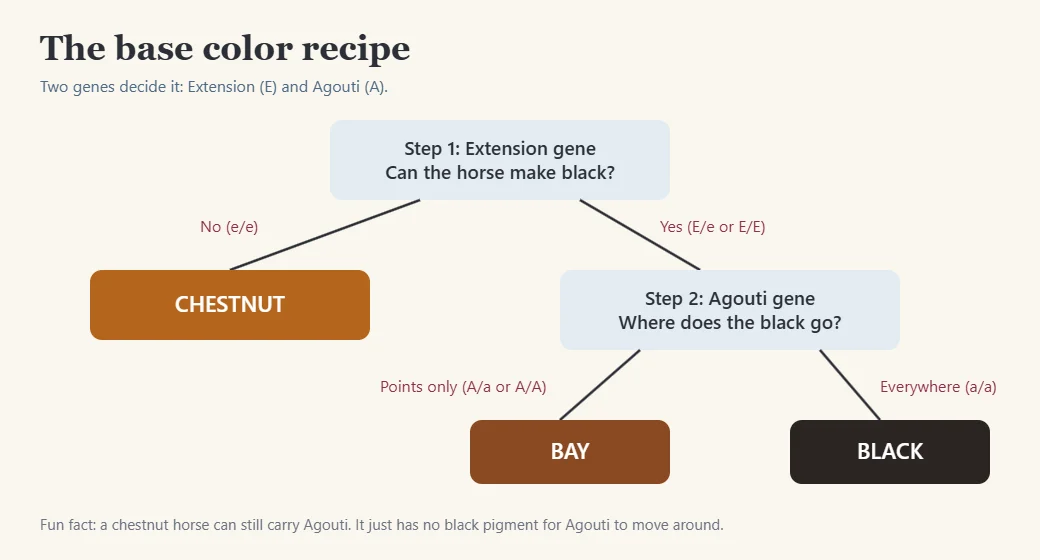
- Extension (E or e) answers: can this horse make black pigment? A horse with e/e cannot, so it’s chestnut (red).
- Agouti (A or a) answers: where does the black go? With at least one A, black stays on the mane, tail, and legs, making a bay. With a/a, black covers the whole body, making a black horse.
That’s why two bays can have a chestnut foal: if both parents are E/e, each has a 1 in 2 chance of passing on e, so there’s a 1 in 4 chance the foal gets e/e.
Let’s mix two colors
A Punnett square is a simple grid that shows every way the parents’ genes can combine. Put one parent’s two copies across the top and the other parent’s down the side, then fill in each box.
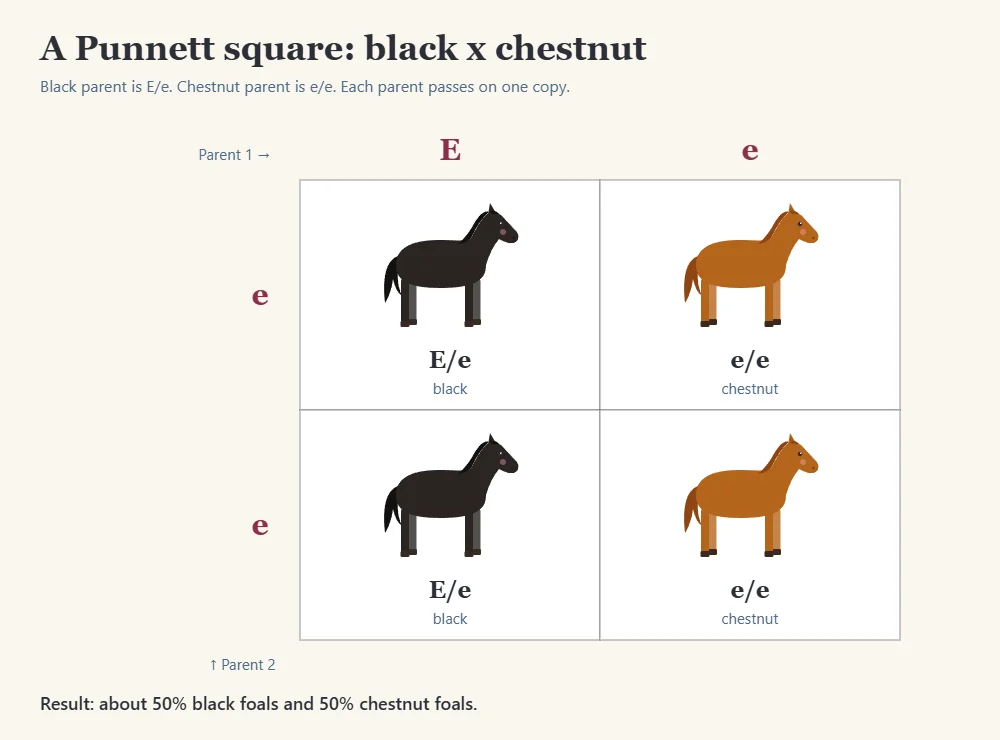
Here a black horse that carries red (E/e) is bred to a chestnut (e/e). Two boxes out of four are E/e (black) and two are e/e (chestnut), so each foal has about a 50% chance of each color.
Cream: where palominos and buckskins come from
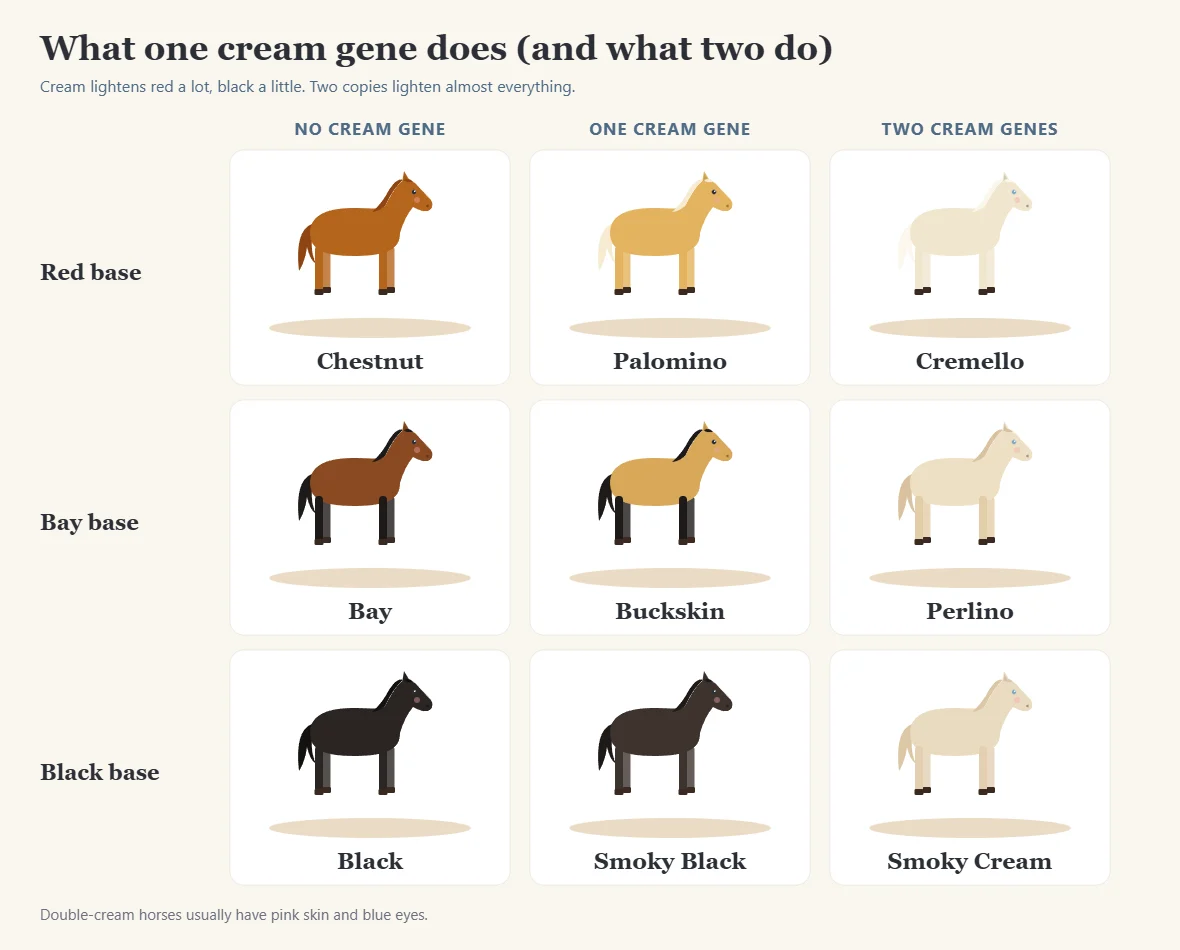
The cream gene lightens the coat. One copy turns chestnut into palomino, bay into buckskin, and black into smoky black (which can look almost black). Two copies make cremello, perlino, or smoky cream: very pale horses that usually have pink skin and blue eyes.
Fun fact: breed a cremello to a chestnut and every foal gets one cream gene, so you’ll get a palomino every time.
Patterns and modifiers
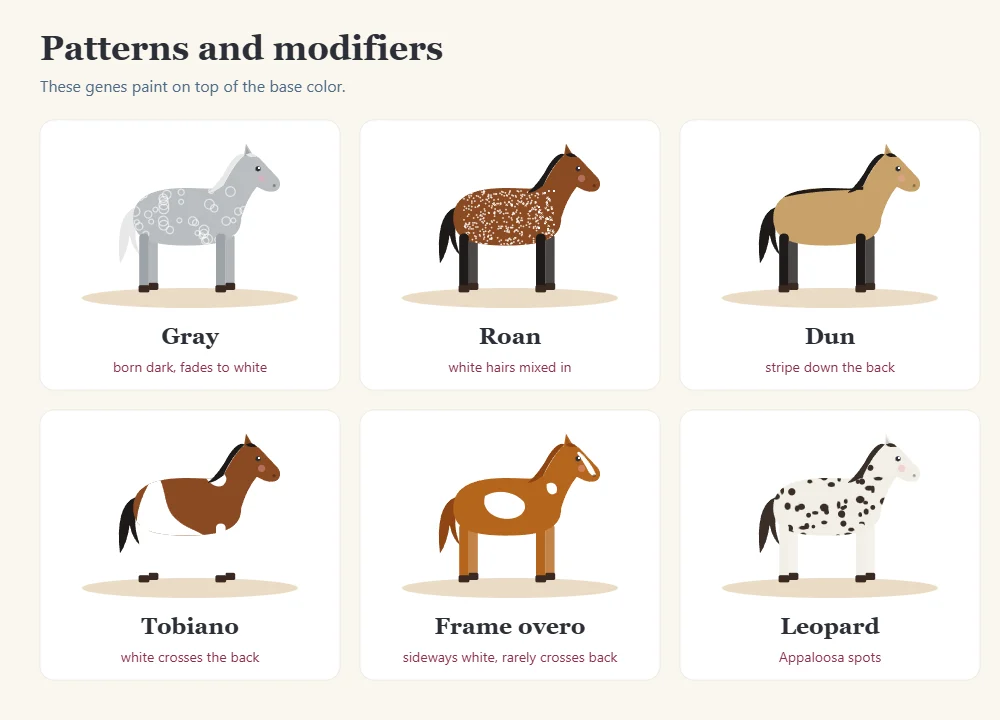
- Gray is dominant. Gray foals are born a normal color and turn white over the years. One thing to know: gray horses get melanomas much more often. UC Davis estimates about 80% of gray horses over 15 have them, so regular skin checks matter.
- Roan mixes white hairs into the body while the head and legs stay dark.
- Dun lightens the body and adds primitive markings like a dark stripe down the back.
- Tobiano makes white patches that usually cross the back, often with white legs.
- Frame overo makes white patches that run sideways and rarely cross the back. This one needs extra care (see below).
- Leopard complex makes Appaloosa spots and patterns.
What to avoid when breeding
Some genes are completely safe with one copy but cause serious problems with two. That’s why responsible breeders DNA test both parents before breeding.
Never breed two frame overo carriers without testing
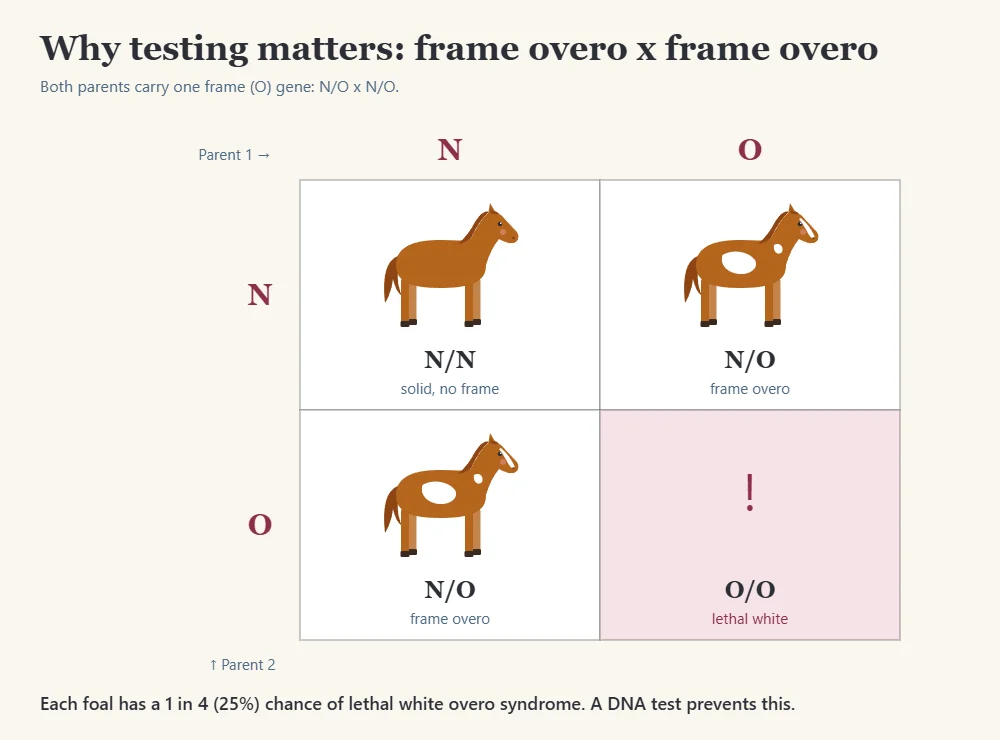
If both parents carry one frame overo gene (N/O), each foal has a 25% chance of being born with lethal white overo syndrome (LWO): an all-white foal whose intestines did not develop properly. There is no cure. A simple DNA test from a lab like UC Davis prevents it, and the American Paint Horse Association requires LWO testing for breeding stallions.
Other genetic conditions to test for
| Condition | Breeds to test | What happens |
|---|---|---|
| Leopard complex night blindness (CSNB) | Appaloosas and other spotted breeds | Horses with two leopard genes (LP/LP) are night blind and at higher risk of uveitis, an eye disease. |
| Warmblood fragile foal syndrome (WFFS) | Warmbloods, some Thoroughbreds | Recessive. Two carriers have a 25% chance of a foal with fragile, tearing skin. |
| AQHA 5-panel: HYPP, GBED, PSSM1, MH, HERDA | Quarter Horses and related breeds | Muscle, skin, and metabolic diseases. Some are dominant (one copy causes it), some are recessive. |
| Cerebellar abiotrophy (CA) | Arabians and Arabian crosses | Recessive. Affects balance and coordination. |
The rule of thumb: if a condition is recessive, avoid breeding two carriers together. Every test result tells you exactly which pairings are safe.
What happens when breeds are mixed?
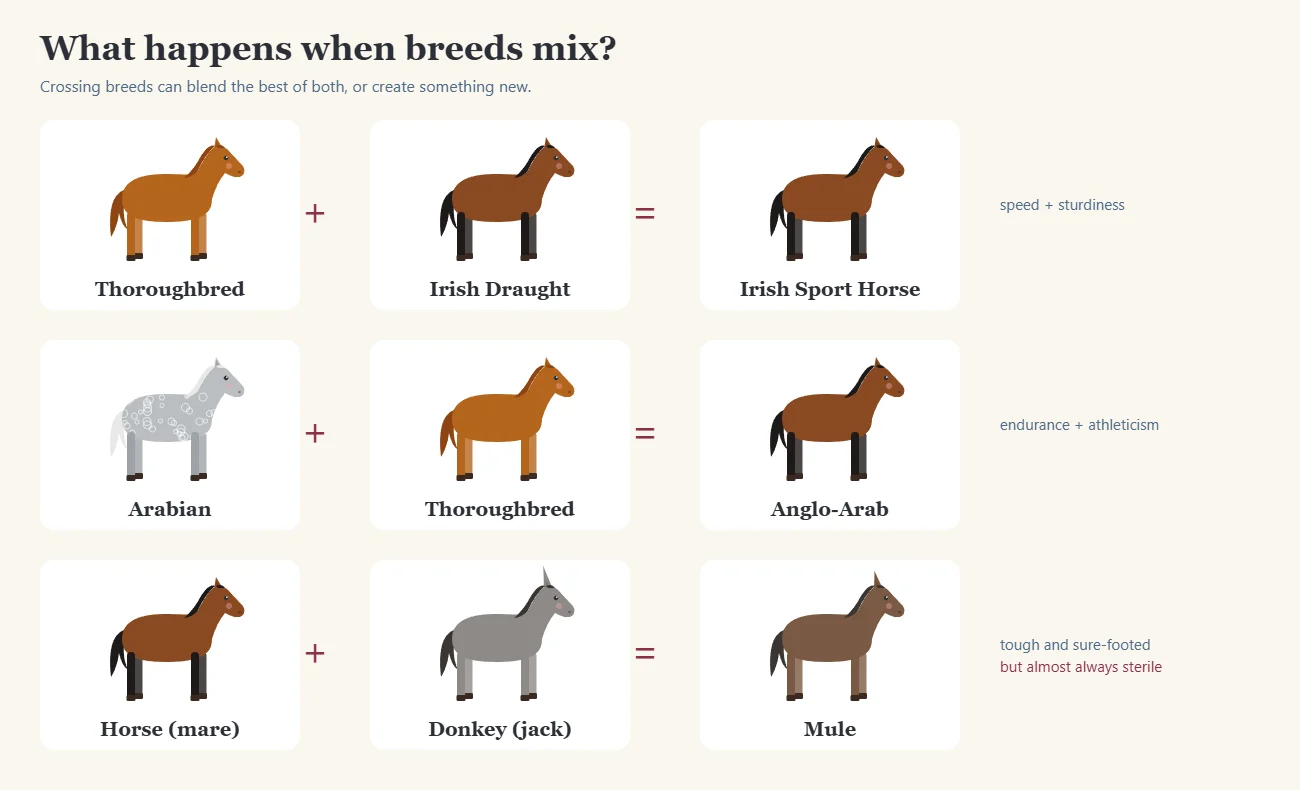
Crossing two breeds can combine the best traits of each. Some crosses are so successful they became breeds of their own:
- Irish Sport Horse: Thoroughbred speed plus Irish Draught strength and good sense.
- Anglo-Arab: Arabian endurance plus Thoroughbred athleticism.
- Mule: a horse mare bred to a donkey jack. Mules are tough and sure-footed, but because horses and donkeys have different numbers of chromosomes, mules are almost always sterile.
Crossing unrelated breeds can also lower the chance that both parents carry the same hidden recessive problem. But a cross is not automatically better. A foal can inherit the weaknesses of both parents just as easily as the strengths.
What creates good outcomes?
- Test both parents for color genes and breed-specific health panels.
- Breed for the horse, not the color. Soundness, conformation, temperament, and purpose come first. Color is the bonus.
- Avoid close inbreeding, which raises the chance of two hidden recessive copies meeting.
- Check your breed registry’s rules. Many require specific DNA tests before registering a foal.
- Work with your vet or a reproduction specialist before breeding.
Quick reference
| Parents | Possible foals |
|---|---|
| Chestnut x chestnut | Always chestnut (unless another gene, like gray or cream, is involved) |
| Cremello x chestnut | Always palomino |
| Bay (E/e) x bay (E/e) | Mostly bay or black, with about a 1 in 4 chance of chestnut |
| Frame overo x frame overo (both N/O) | 25% chance of lethal white. Test first! |
| Horse mare x donkey jack | Mule (almost always sterile) |
This post is for education only. I’m not a veterinarian or geneticist. Always talk to your vet and use an accredited genetics lab before breeding.
Sources
- UC Davis Veterinary Genetics Laboratory: horse coat color panel
- UC Davis VGL: Lethal White Overo (LWO)
- UC Davis Center for Equine Health: Lethal White Overo syndrome
- UC Davis VGL: Leopard complex, night blindness, and uveitis
- UC Davis VGL: Fragile foal syndrome (WFFS)
- UC Davis VGL: Cerebellar abiotrophy
- UC Davis School of Veterinary Medicine: Equine melanomas
- University of Georgia: Genetic testing and breeding (AQHA 5-panel)